
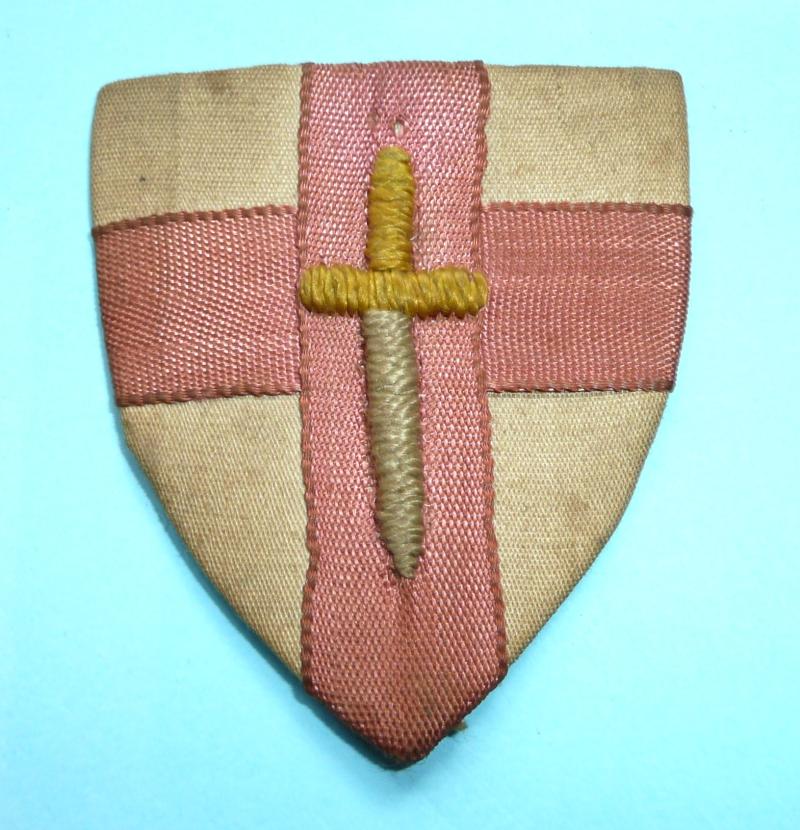
WW2 1st Army / 2nd AGRA (Army Group Royal Artillery) Theatre Made Embroidered Formation Sign Patch Flash Designation Patch
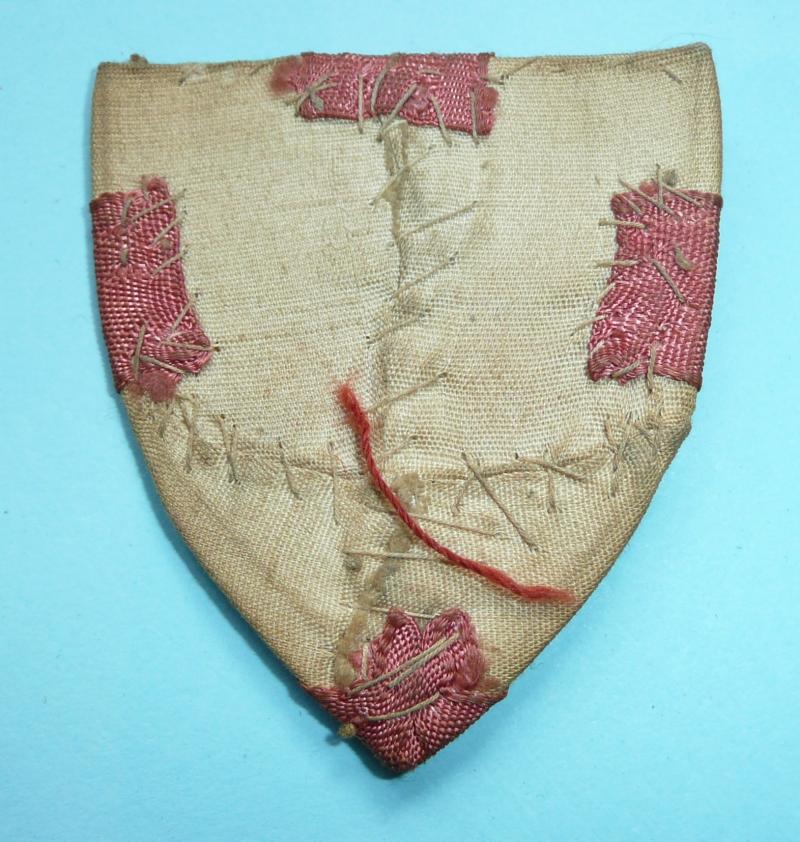
A handmade example, presumably theatre made (possibly in Italy or Greece), sewn tightly over a piece of card. It has a charming look to it. Some sun fade from wear. Removed from uniform.
It depicts a gold-hilted Crusader's sword pointing down, superimposed on a red St. George's cross on a white shield.
The 1st Army was disbanded after the end of hostilities in North Africa. The badge was subsequently adopted by 2nd Army Group Royal Artillery (AGRA). Other than 6th AGRA, most AGRA HQs and their subordinate units wore the relevant Army, or possibly Army Group, sign. 2nd AGRA was formed in Darlington in September 1942 with the object of going to North Africa as part of 1st Army, under command of IX Corps. It arrived in March 1943 and fought there to the end of the campaign. When 1st Army and IX Corps HQ were disbanded, HQ 2nd AGRA was saved and allocated, with different units under command, to X Corps under the American Fifth Army for the Salerno operation. It was at this time that '... Lieutenant-General Sir Kenneth Anderson passed on the legacy of the First Army sign to 2 AGRA, who then acquired and wore with great pride the crusader's shield with the St George's cross and sword.' The badge was probably worn on the left shoulder, the 8th Army badge on the right (see 6th AGRA). 2nd AGRA fought throughout the Italian campaign. At the end of the War it was responsible, with 21st Tank Brigade, for guarding some 150,000 'Suspected Enemy Persons' in the Rimini area. In January 1946 HQ 2nd AGRA went to Greece as an infantry brigade HQ (180 Infantry Brigade).
Comm MaWi
Sold to PL
Code: 69782